
Views: 0 Author: Site Editor Publish Time: 2026-11-25 Origin: Site


Facility managers face immense operational risks when backup power falls short. Failing annual life safety inspections can lead to steep compliance fines. Worse, undersized emergency power exposes facilities to serious liability during sudden electrical outages. Transitioning to modern LED fixtures significantly lowers overall wattage demands across your building. You might assume this makes backup power less of a concern. However, precise runtime calculation remains absolutely mandatory to satisfy strict fire codes. Accurately calculating an Emergency Light Battery requirement ensures full regulatory compliance. It prevents premature system failure during critical emergencies. It also informs the technical decisions you make between legacy chemistries and modern power upgrades. We will explore how to calculate actual wattage loads, apply vital degradation buffers, and select the right chemistry for your safety infrastructure. Proper sizing protects occupants and secures facility operations alike.
Regulatory Baseline: NFPA 101 and IBC require a minimum of 90 minutes of continuous illumination during a power failure.
The Core Metric: Battery capacity must be calculated in Watt-hours (Wh) or Amp-hours (Ah), explicitly factoring in the specific draw of LED drivers and inverters.
The Buffer Rule: Nameplate capacity does not equal real-world runtime; a 20% to 30% margin is required for thermal degradation and aging.
Chemistry Matters: Upgrading to a LiFePO4 emergency light battery dramatically alters lifecycle ROI compared to traditional Sealed Lead Acid (SLA) or Nickel-Cadmium (NiCd) units.
Building codes leave no room for guesswork regarding life safety. The National Fire Protection Association outlines strict mandates in NFPA 101, known as the Life Safety Code. Alongside the International Building Code (IBC) and UL 924 standards, these regulations establish a universal requirement. Backup lighting systems must provide exactly 90 minutes of continuous emergency illumination.
This 90-minute window ensures occupants have sufficient time to safely evacuate a building. It also gives first responders adequate lighting to navigate corridors, stairwells, and complex floor plans. Meeting this standard requires more than just turning the lights on. The system must maintain a specific performance threshold throughout the entire event.
Inspectors measure battery voltage to verify true compliance. According to industry standards, an emergency power unit must sustain at least 87.5% of its nominal voltage at the very end of the 90-minute cycle. If the voltage drops below this threshold at minute 89, the fixture fails the test.
Common Mistakes in Compliance Calculations
Ignoring parasitic drain from internal circuit boards.
Failing to account for temperature swings in unconditioned spaces.
Relying strictly on day-one laboratory specifications.
This creates a significant business problem for facility managers. Many teams calculate their required power capacity for exactly 90 minutes based on day-one specifications. A brand-new battery might pass this test easily. However, natural chemical degradation begins immediately after installation. By year two, a battery sized exactly for a 90-minute load will likely drop voltage at minute 80. This leads to costly compliance failures during annual testing.
You cannot purchase reliable backup power without understanding your exact electrical load. Converting your fixture's power requirements into battery capacity metrics ensures you buy the right unit. Follow these three steps to size your system accurately.
Determine Total Connected Load: First, you must sum the wattage of all connected LED arrays. Do not forget to add the power consumption of the emergency LED driver or internal inverter. These components consume power just to operate.
Calculate Required Watt-Hours (Wh): You measure energy consumption over time using Watt-hours. Multiply your Total Wattage (W) by 1.5 hours. This represents the mandatory 90-minute runtime. The resulting number is your Target Wh.
Convert to Amp-Hours (Ah) for Procurement: Most manufacturers rate their batteries in Amp-hours. To find your required Ah, divide your Target Wh by the System DC Voltage. Common voltages include 3.6V, 6V, 9V, or 12V.
Practical Calculation Example
Let us walk through a standard dual-head LED exit sign calculation. We want to ground this math in a real-world scenario.
The Load: You have an exit sign with two LED lamp heads. Each head draws 3 Watts. The internal emergency inverter consumes 1 Watt of continuous power.
Total Wattage: 3W + 3W + 1W = 7 Watts.
Required Watt-Hours: 7W multiplied by 1.5 hours equals 10.5 Wh.
Convert to Amp-Hours: This specific fixture operates on a 6V DC system. You divide 10.5 Wh by 6V. This equals 1.75 Ah.
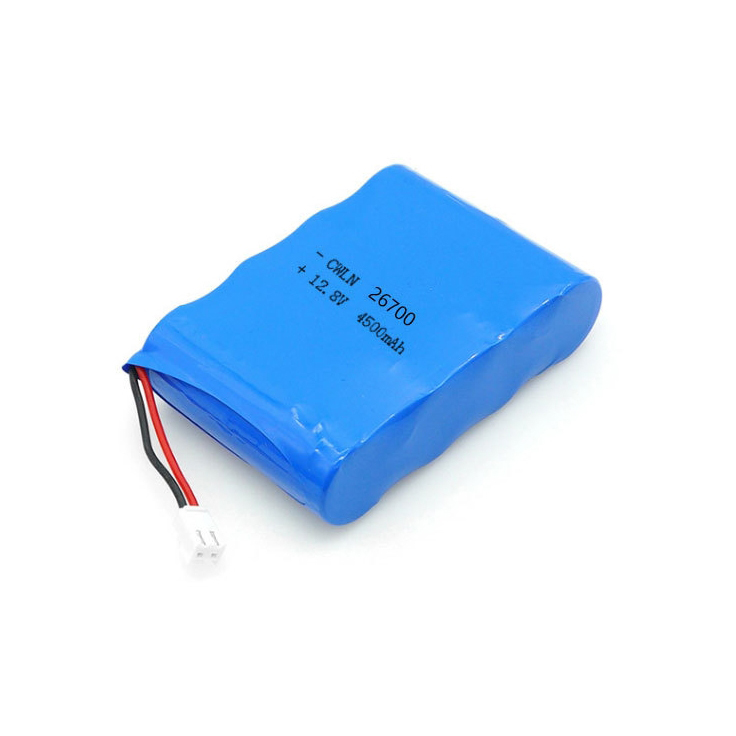
On paper, a 6V 1.75Ah battery perfectly meets the requirement. However, buying a battery that exactly matches this number will guarantee a failed inspection in the future. To ensure long-term reliability, you must source a properly buffered LED Emergency Lighting Battery Pack that accounts for real-world losses.
Theoretical math assumes perfect conditions. Facilities rarely operate in perfect environments. When you calculate emergency power loads, you must account for energy lost to heat, conversion inefficiency, and environmental stress.
Inverter efficiency loss represents the first hidden drain on your system. Battery power is stored as Direct Current (DC). Many LED drivers require Alternating Current (AC) or stepped-up DC voltage. The conversion process from DC-to-DC or DC-to-AC wastes energy. Standard inverters lose 10% to 15% of the battery's stored energy entirely to heat. If you ignore this loss, your calculated 90-minute runtime immediately shrinks to 76 minutes.
Extreme temperatures further reduce effective Amp-hour capacity. Standard ratings assume an ambient temperature of 77°F (25°C). Cold environments drastically slow down the internal chemical reactions. Installing a fixture in an unheated parking garage or outdoor breezeway can reduce available capacity by up to 40%. Conversely, excess heat in warehouses or mechanical rooms accelerates internal degradation. A battery might deliver full capacity in high heat initially, but it will permanently lose its ability to hold a charge much faster.
Best Practices for the Safety Margin
You must protect your facility against these inevitable losses. We strongly instruct buyers to apply a safety margin multiplier to their baseline calculations.
Take your base Ah calculation and multiply it by 1.25x or 1.3x.
Using our previous example (1.75 Ah), a 1.3x multiplier equals 2.27 Ah.
You would then procure a 6V 2.5Ah or 3Ah battery for that specific fixture.
Applying this margin ensures the system possesses enough overhead capacity to pass the rigorous 90-minute test even in years three and four of operation.
Once you determine your required capacity and apply your safety buffer, you must choose the right chemistry. Different battery types react differently to discharge cycles, temperature, and standby states.
Sealed Lead Acid (SLA)
SLA technology dominates older building infrastructure. These units offer high availability and a very low upfront procurement cost. However, they carry significant physical weight. They are also highly sensitive to temperature fluctuations. If left uncharged, they sulfocate and fail rapidly. SLA units work best for large, climate-controlled central inverter systems rather than individual wall fixtures.
Nickel-Cadmium (NiCd) & Nickel-Metal Hydride (NiMH)
NiCd and NiMH chemistries serve as the legacy standard for compact exit signs and small fixtures. They handle heat slightly better than SLA. Unfortunately, they suffer from the "memory effect." If a facility does not cycle them properly through full discharges, they "forget" their total capacity. They typically offer a moderate lifespan of 3 to 5 years before requiring complete replacement.
Lithium Iron Phosphate (LiFePO4)
Modern facilities increasingly specify a LiFePO4 Emergency Light Battery for new installations and retrofits. This chemistry requires a higher upfront investment. However, it delivers exceptional operational benefits.
They offer two to three times the cycle life of traditional SLA units.
They support deeper discharge capabilities without suffering extreme voltage drops.
They feature significantly smaller physical footprints, making them ideal for low-profile, architectural LED fixtures.
This technology serves as a primary decision driver for facility teams. We recommend LiFePO4 for operations seeking to lower long-term maintenance labor costs. Replacing units every eight years instead of every three years frees up internal maintenance teams for more critical building tasks.
Common Battery Chemistries Comparison
Chemistry Type | Weight/Profile | Temperature Tolerance | Expected Lifespan |
|---|---|---|---|
Sealed Lead Acid (SLA) | Heavy / Bulky | Poor | 2 - 4 Years |
Nickel-Cadmium (NiCd) | Light / Compact | Moderate | 3 - 5 Years |
Lithium Iron Phosphate (LiFePO4) | Ultra-Light / Low Profile | Excellent | 7 - 10 Years |
Accurate math and superior chemistry mean nothing if the battery does not fit inside the fixture. Implementation carries several physical and electronic risks.
You must perform strict compatibility verification before placing bulk orders. Never match voltage and Amp-hours without checking physical dimensions first. A 10Ah battery takes up significantly more space than a 7Ah battery. If it cannot fit inside the housing, you cannot close the fixture safely.
Furthermore, you must match terminal types perfectly. Standard SLA units use either F1 (0.187-inch) or F2 (0.250-inch) spade connectors. Forcing an F1 wire harness onto an F2 terminal damages the connector and creates a fire hazard. Many modern LED fixtures use proprietary plastic wire harnesses. You must verify that your replacement unit includes the correct plug.
You also need to align your testing protocols. Many modern fixtures feature automated self-testing capabilities. They run short diagnostic tests every 30 days and a full 90-minute test annually. Ensure your selected LED Emergency Lighting Battery Pack integrates flawlessly with the fixture's internal charge controller. Some older charge controllers struggle to read the voltage curves of modern lithium upgrades.
When you prepare your shortlisting logic, advise your purchasing department to look beyond the lowest price per Amp-hour. Evaluate vendors based on clear UL certification visibility. Examine their stated operational temperature ranges. Prioritize suppliers who offer extended warranty lengths. A slightly higher upfront component cost is vastly preferable to failing a life safety inspection due to cheap manufacturing.
Life safety regulations leave zero margin for error during critical power failures. Exact runtime calculations represent a non-negotiable requirement for facility compliance. By converting your total connected wattage into Amp-hours, you establish a solid baseline. Applying a 20% to 30% degradation buffer guarantees that your system will perform flawlessly for years, not just on the day of installation.
Take proactive steps today to secure your building. Audit your current backup lighting systems immediately. Identify units that failed their most recent 90-minute tests. Calculate their true load requirements using the formulas provided. Finally, source appropriately sized, high-quality replacement batteries from certified suppliers to restore complete compliance and protect your occupants.
A: Yes, you can install a higher capacity unit as long as the voltage is exactly identical. You must also verify that it physically fits inside the existing housing. A higher Ah rating simply provides a longer runtime buffer, ensuring it easily passes the 90-minute test as it ages.
A: You should typically replace traditional SLA or NiCd units every 3 to 5 years. However, you must replace them immediately if they fail the annual 90-minute discharge test, whichever comes first. Modern LiFePO4 batteries may last between 7 and 10 years before requiring replacement.
A: No. Emergency calculations must always rely on the wattage drawn by the emergency driver output during a complete power failure. Backup systems typically bypass standard architectural dimming controls entirely to provide a fixed, code-compliant lumen output during emergencies.


