
Views: 0 Author: Site Editor Publish Time: 2026-07-03 Origin: Site


Small apparel decorators often face a frustrating daily bottleneck. Achieving vibrant, durable prints on dark garments usually demands high setup efforts. Traditional screen printing requires burning screens and messy chemical washouts. Alternatively, direct-to-garment (DTG) printing exposes you to strict fabric limitations and tedious pretreatments. The apparel industry standard has rapidly shifted to solve this exact problem. Today, the CMYKW (Cyan, Magenta, Yellow, Key/Black, White) workflow dominates modern film-to-fabric transfers. It allows you to print complex, full-color graphics quickly. You completely bypass tedious vinyl weeding and sticky garment pretreatments.
This guide helps business owners evaluate a commercial dtf printing machine for apparel effectively. We will focus deeply on true workflow realities and hardware evaluation. You will learn how to identify reliable printhead architectures. We will explore essential ink management systems. You will also discover the necessary environmental controls to keep production running smoothly. Our goal equips you with the practical knowledge needed to scale your decoration operations profitably.
A dedicated CMYKW DTF printer relies on the White (W) channel as an underbase, dictating both opacity on dark fabrics and overall system maintenance.
Dual-printhead configurations separate color and white inks, drastically improving production speed for small businesses compared to converted desktop printers.
Hardware evaluation must prioritize white ink circulation systems; stagnant white ink is the primary failure point in DTF adoption.
Total cost of ownership (TCO) extends beyond the printer, requiring investment in RIP software, powder shakers, and proper ventilation/curing setups.
Consider the daily friction in a standard decoration shop. You receive a custom order for ten dark nylon jackets. Traditional screen printing takes hours just to set up the artwork. Direct-to-garment ink simply washes off slick nylon fabrics. Heat transfer vinyl requires an eternity of manual weeding for detailed logos. This scenario highlights the core problem many shops face. The limitations of older methods kill margins on small, custom runs.
Substrate versatility changes the game entirely. You can press DTF transfers onto a massive variety of fabrics. They adhere beautifully to standard cotton and complex polyester blends. They even work perfectly on treated nylon or canvas. This flexibility opens up entirely new product categories for your shop. You no longer have to turn away challenging fabric requests.
What defines a successful small business DTF investment? Efficiency matters most. You want sub-3-minute print-to-press times. You need a system that operates reliably every single day. Minimal daily downtime ensures a steady production flow. Profitability ultimately relies on achieving a low per-print consumable usage. You want to produce retail-quality shirts without wasting expensive ink or film.
Bridging the operational gap requires the right technology. A dedicated five color DTF system creates massive new opportunities. Small shops can finally accept low-minimum orders without stress. You can print one to twenty units highly profitably. Setup times drop practically to zero. Wash-fastness matches or exceeds traditional methods. You deliver commercial-grade durability. Customers receive vibrant, long-lasting apparel.
Understanding the actual printing mechanics helps you troubleshoot future issues. The standard four-color process handles the visual foundation. Cyan, Magenta, Yellow, and Key (Black) combine seamlessly. They create thousands of photorealistic color variations. The machine prints this high-resolution graphic layer directly onto the special PET film. This layer mirrors your original digital artwork perfectly. It produces smooth color gradients and incredibly crisp typography. You print this specific color layer first.
The white layer acts as your critical foundation. Dedicated machines print a dense white underbase over the color layer. They lay it precisely over the wet CMYK inks. Dual-head machines accomplish this heavy lifting in a single rapid pass. The white ink provides ultimate opacity. It actively stops dark garment dyes from migrating through the graphic. Without a solid white layer, colors look muddy and faded on black shirts. The white layer makes the vibrant colors pop.
Powder application and curing integration happen immediately next. You apply finely milled TPU adhesive powder to the film. It coats the wet white ink evenly. You shake off any excess powder from the unprinted areas. Then, the film enters a specialized curing oven. Consistent heat melts the TPU powder into a rubbery, flexible adhesive layer. This process creates the final transfer. Now, it is fully ready for any custom fabric printer application. You can press it immediately or store it for months.
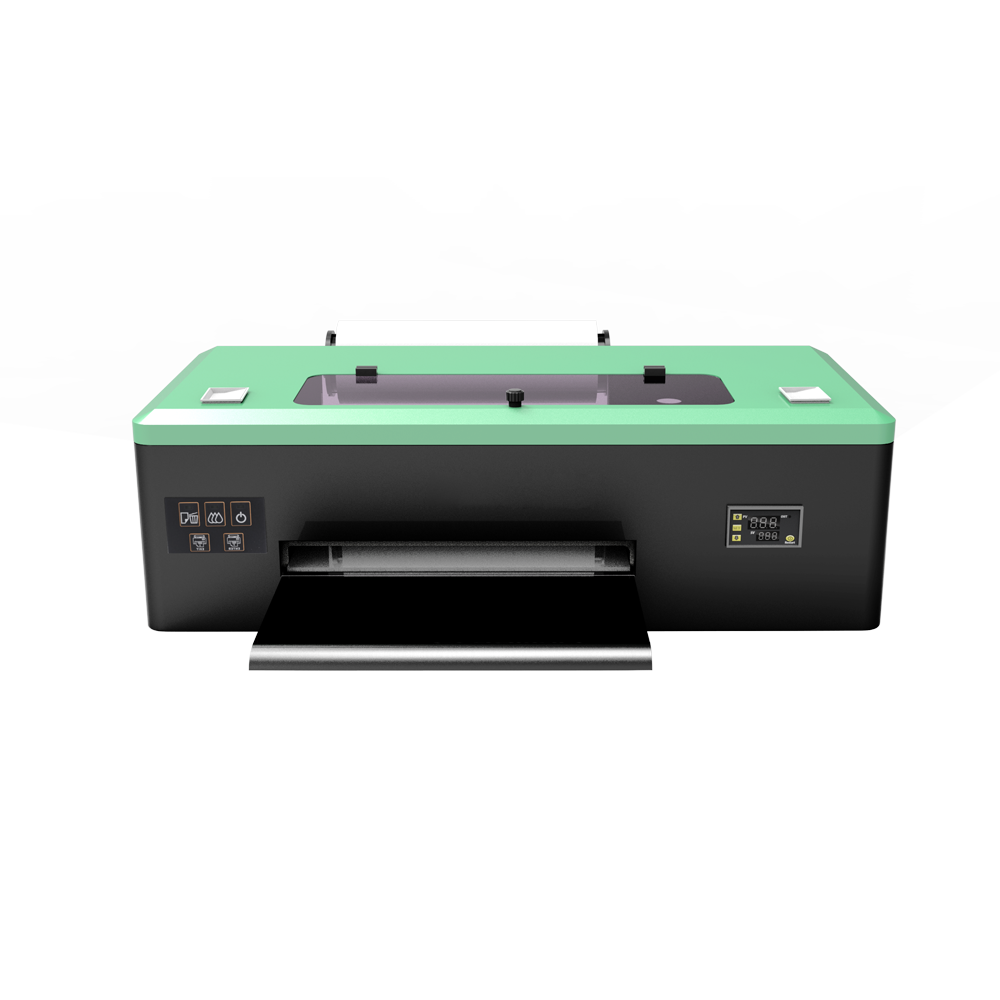
Evaluating hardware feels overwhelming at first glance. Focus entirely on the core mechanical architecture. Printhead configuration dictates your daily output speed and reliability. Single printhead models print color first, then reverse to print white. They run significantly slower. They also face a higher risk of ink mixing inside the dampers.
Dual printhead models solve these specific production issues. They use industry-standard commercial heads like the Epson i3200 or XP600. One head dedicates itself entirely to the CMYK colors. The other handles only the heavy white ink. This separation practically doubles your production speeds. It also significantly reduces internal mechanical strain.
We can clearly see the differences in hardware capabilities below:
Architecture Type | Speed Level | Primary Use Case | Maintenance Need |
|---|---|---|---|
Single Printhead (Converted) | Slow | Hobbyists, low volume | High (prone to mixing) |
Dual Printhead (XP600) | Medium | Growing small shops | Moderate |
Dual Printhead (i3200) | Fast | High-volume commercial | Standard daily routine |
Ink management systems represent the ultimate trust factor. White ink contains heavy titanium dioxide pigments. These particles settle rapidly when the machine sits idle. You must have active white ink circulation. Mechanical agitation systems stir the ink constantly inside the main tank. Risk warning: Machines lacking these features suffer catastrophic head clogs. Do not compromise on ink management. A cheap machine without circulation always breaks down.
Software capabilities determine your final print quality. You need robust RIP programs like CADlink or Flexi. They provide precise white-layer choking tools. Choking pulls the white underbase slightly inward from the color edges. This prevents ugly white borders from peeking around your graphics. The software also controls crucial ink channel limits. It prevents excess ink from pooling on the film.
Footprint and scalability guide your final choice. Desktop roll-to-roll models fit nicely in small studios. They suit moderate daily volumes extremely well. Commercial 24-inch models require dedicated warehouse floor space. They usually pair with automated inline powder shakers and large ovens. Match the hardware width exactly to your projected daily demand.
Many new operators drastically underestimate the daily maintenance cadence. You must adopt a strict, non-negotiable cleaning routine. Perform daily head cleanings without fail. Print test nozzle checks every single morning before production begins. Clean the rubber capping station regularly to ensure a tight vacuum seal. DTF is definitely not a plug-and-play technology. You cannot simply turn it off and ignore it for a week. Ignoring maintenance destroys expensive printheads rapidly.
Environmental controls play a massive role in your success. Maintain strict humidity levels between 40% and 60%. Keep the room temperature consistently moderate. Dry air causes severe static electricity issues. Static makes adhesive powder stick where it shouldn't, causing speckled shirts. Improper temperatures alter the ink viscosity. This leads to inconsistent flow and frustrating color banding in your prints.
Safety and compliance demand your immediate attention. Melting TPU powder releases volatile fumes. You absolutely need adequate fume extractors. Connect these extractors directly to your curing ovens. Never operate these systems in unventilated spaces. Respiratory risks pose a genuine hazard to your health over time. Always exhaust these fumes outdoors whenever possible.
Consumables directly impact your operational return on investment. Quality varies wildly among different PET films. Hot peel films speed up your pressing workflow significantly. Cold peel films often leave a smoother, more matte finish. Cheap adhesive powder degrades overall wash durability. It cracks and peels after just a few laundry cycles. Invest in premium consumables from the start. They guarantee repeat customers and reduce wasted garments.
Shake ink tanks gently every morning before powering on the machine.
Use distilled water and specialized swabs to clean the wiper blade.
Keep a digital hygrometer next to the printer to monitor humidity.
Store unused PET film inside sealed bags to prevent moisture absorption.
Leaving the machine powered off completely during long weekends.
Mixing different brands of white ink inside the same damper system.
Baking the TPU powder at temperatures that are too high, causing bubbling.
Placing the printer directly underneath an active air conditioning vent.
Scaling requires logical tiering based on your actual order volume. Do not overbuy hardware before you have the customer base to support it.
For Side-Hustles (Under 50 shirts/week): Look at entry-level setups. A 13-inch roll-to-roll setup offers a great middle ground. It handles steady work without overwhelming a small room. You will manually powder and cure the film, which saves space.
For Scaling Shops (100+ shirts/week): Upgrade your gear to meet demand. You need commercial 24-inch dual-head setups. Pair them with automated inline powder shakers. This eliminates the tedious manual powdering process entirely. It frees you up to press shirts simultaneously.
Vendor vetting saves you massive headaches later. Always advise buyers to request custom sample prints. Never just accept the vendor's pre-made, optimized sample files. Send them your own complex artwork. Specifically, test a graphic with a soft gradient fading into nothing. Ask them to press it onto a dark garment. This evaluates the white ink performance accurately. If the gradient looks harsh or blocky, the RIP software or hardware is failing.
Warranty and support dictate your long-term survival in this industry. Warn against direct-importing cheap white-label machines from overseas. Saving money upfront often means you get zero domestic tech support later. You will struggle to find available replacement printheads when things break. Buy from vendors offering fast, localized assistance. Even a premium CMYKW DTF printer requires occasional troubleshooting. You need a reliable partner to help you fix it quickly.
This technology transforms apparel decoration shops completely. A dedicated CMYKW machine serves as a highly profitable asset. It fundamentally lowers the barrier to complex, multi-color apparel decoration. You can finally say yes to intricate designs on tough fabrics. The learning curve exists, but it remains highly manageable. You just need to respect the strict environmental and ongoing maintenance requirements.
Stop turning away profitable dark-garment orders due to technical limitations. Take actionable steps toward upgrading your shop's capabilities. Evaluate your current weekly volume realistically. Request a custom print sample from a reputable dealer using your own artwork. Schedule a virtual or in-person hardware demo today. Seeing the actual speed and transfer quality in person provides the best clarity for your business decisions.
A: White ink contains heavy titanium dioxide pigments. These particles settle very quickly when sitting still. Circulation systems keep the fluid moving constantly. This prevents the heavy pigment from separating from the liquid base. It stops the microscopic nozzles in the printhead from permanently clogging. Without active circulation, you will be forced to replace expensive printheads constantly.
A: Yes, absolutely. Sublimation only works on light-colored polyester. Direct-to-garment printing struggles heavily on synthetic fabrics. DTF solves this completely. The thick white underbase blocks dark garment dyes from migrating upward. The lower pressing temperatures prevent the delicate polyester fabric from scorching or shining. It makes this process ideal for customizing dark athletic wear.
A: Desktop models fit easily on a standard sturdy workbench. However, true automated roll-to-roll systems demand much more room. You need dedicated space for the printer, the inline powder shaker, and the curing oven. This configuration requires at least 8 to 10 feet of linear space. You also need additional room for proper ventilation equipment.
A: Yes. You cannot print directly from standard design programs like Photoshop or Illustrator. Specialized RIP (Raster Image Processor) software is absolutely required. It translates your standard image files into separate CMYK and White data channels. It controls precise ink limits, manages complex color profiles, and handles crucial white underbase choking to prevent borders.


