
Views: 0 Author: Site Editor Publish Time: 2026-07-02 Origin: Site


Upgrading your decoration capabilities requires careful planning and foresight. Many decorators start with manual setups before hitting severe production ceilings. Shifting from entry-level sheet printing to a continuous roll system fundamentally changes your production economics. Scaling up introduces entirely new variables into your daily routine. Specifically, web tension, white ink separation, and curing synchronization dictate operational success.
These critical factors decide whether your equipment generates steady output or creates constant maintenance bottlenecks. We provide a realistic, evidence-based framework for configuring a dtf printing machine for apparel. Our approach focuses heavily on mitigating downtime and achieving predictable production rates. You will learn how to optimize your workflow setup, evaluate ink delivery systems, and synchronize complex hardware pipelines.
Following this guide ensures smoother daily operations and consistent print quality. Your output reliability will improve dramatically when applying these core principles to your workflow.
Automated White Ink Management Systems (WIMS) are mandatory, not optional, for continuous roll production to prevent printhead clogging.
Workflow efficiency relies heavily on the physical and software synchronization between the printer, powder shaker, and curing dryer.
Proper environmental control (humidity and temperature) accounts for over 50% of successful wide format DTF implementations.
Evaluating a system based on total cost of ownership (including maintenance labor and printhead replacement) is more accurate than comparing baseline hardware costs.
Upgrading from desktop or sheet-fed systems requires a clear production threshold. A continuous DTF roll printer becomes economically viable when you process over 50 garments daily. Below this volume, the maintenance overhead often outweighs the automation benefits. Manual sheet loading severely throttles your output capacity as your business grows. Transitioning to a roll-fed system removes these bottlenecks entirely and frees up your operators.
Versatility represents another major advantage of adopting wider commercial formats. Modern equipment acts as a highly efficient bulk garment decorator. It also serves as a perfectly reliable promotional product printer. You can print extensive gang sheets containing varied designs. These diverse graphics can apply to canvas bags, hats, hoodies, and jackets all within the exact same production run.
Hardware evaluation demands strict and objective criteria. Printhead configuration directly impacts both pass rates and overall output speeds. Dual printhead setups traditionally separate the CMYK channels from the white channels. This setup provides a reliable baseline for medium-volume shops. Quad printhead models increase output speeds significantly. They allow much faster production without sacrificing fine image resolution.
Media handling mechanisms require equally close inspection. You need consistent pinch rollers to grip the film securely across its entire width. A strong vacuum bed keeps the media perfectly flat beneath the print carriage. Adjustable tension bars prevent the film from wandering laterally during long print runs. Finally, massive chassis stability minimizes mechanical vibration. Heavy-duty build quality prevents micro-banding artifacts during high-speed carriage movements. Always prioritize physical stability when evaluating machine frames.
Managing white ink remains the single biggest operational hurdle for decorators. White ink relies on heavy titanium dioxide particles to achieve maximum opacity. These microscopic particles settle rapidly when left stationary inside tubes or tanks. This rapid settling causes severe clogging inside delicate printhead nozzles.
You must understand the distinct difference between basic agitation and full circulation. Basic agitation simply shakes or stirs the main ink tank. It works adequately for low-volume desktop setups. However, it leaves the long ink lines highly vulnerable to settling overnight. Full circulation utilizes an advanced White Ink Management System (WIMS). The system actively pumps ink from the main tank, cycles it through the dampers, and returns it. This constant movement is strictly critical for uninterrupted production on any commercial film transfer printer.
Investing in high-quality, certified inks drastically improves system performance. Premium inks undergo extensive degassing processes during manufacturing. Degassed fluids remove trapped micro-bubbles from the chemical solution. This process directly reduces damper failure rates. It also minimizes unpredictable nozzle deflection during extensive daily print runs.
Beware the false economy of sourcing cheap, unverified inks. Substandard chemical formulas often lead to premature printhead failure and inconsistent wash fastness. Factoring the expense of sudden printhead replacements fundamentally changes your operational math. Lost production time costs far more than saving a few dollars on premium ink bottles. Choose long-term reliability over upfront consumable savings.
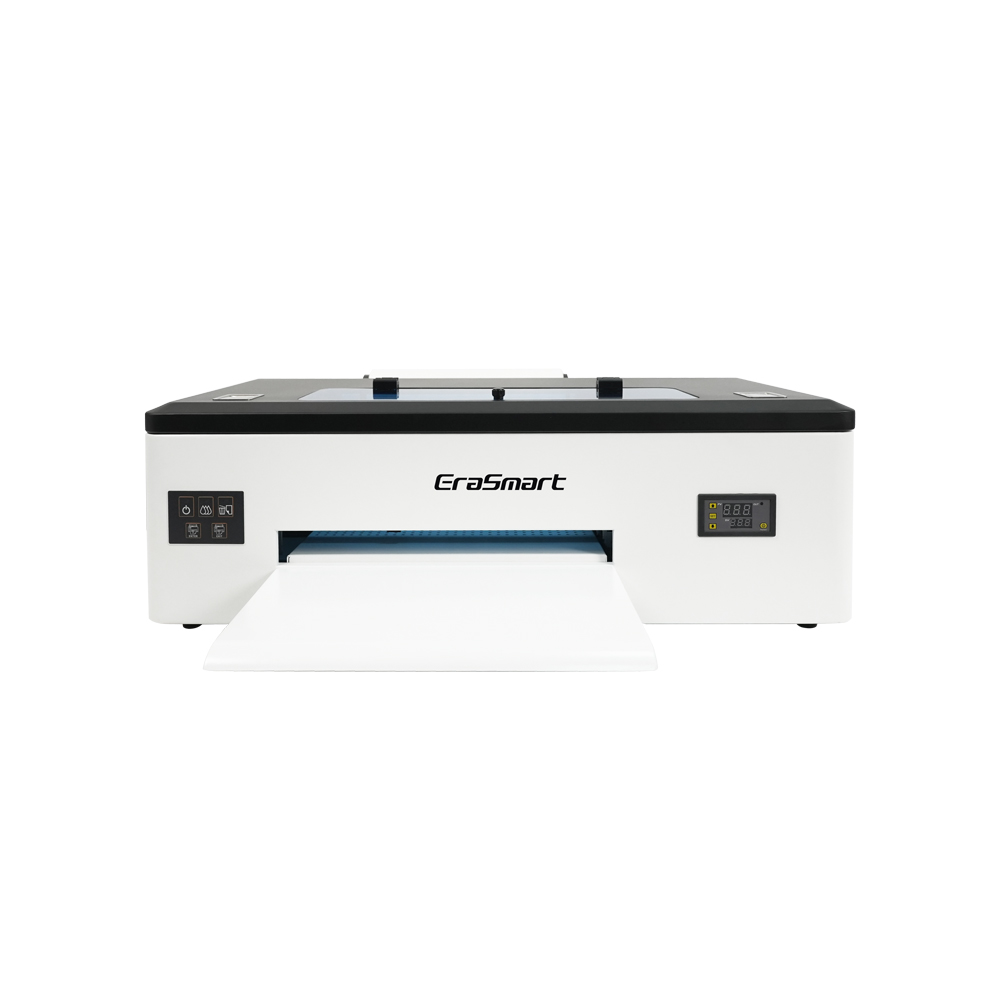
Building an automated line requires adequate physical space and careful facility planning. You must measure and plan the entire system footprint before installation. Proper ventilation channels harmful fumes away from machine operators. Dedicated power circuits prevent unexpected breaker trips during high-draw heating cycles.
Connecting the hardware pipeline requires precise physical adjustments across all components. Pay close attention to these three core stages:
Film Feed and Tension: Establish optimal tension between your film transfer printer and the automated powder shaker. Proper web tension prevents catastrophic head strikes. It also stops the PET film from buckling before it enters the powder application zone.
Powder Application Dynamics: Tune the shaker frequency carefully based on your current job. Adjust the internal weight sensors for consistent TPU adhesive coverage. Proper tuning minimizes excess powder waste falling outside the collection tray. It ensures every pixel of wet ink receives sufficient adhesive.
Curing Phase Management: Set optimal temperature zones inside the tunnel dryer. You want to fully melt the adhesive granules into a smooth, glossy layer. However, excessive heat will warp the PET film. Warped film causes severe alignment issues during the final heat press stage.
Software synchronization ties these distinct physical components together seamlessly. Use your dedicated RIP software to control precise film feed rates. The printer's output speed must perfectly match the powder shaker's intake capacity. Poor synchronization leads to film bunching inside the shaker chamber. It can also cause stretching, which permanently distorts your printed designs. Establish a harmonious workflow where software and hardware communicate flawlessly.
Professional results require rigorous and frequent calibration routines. Large commercial equipment demands precise physical alignments specific to 24-inch or larger roll widths. Start by performing a standard bidirectional alignment. This ensures ink droplets land exactly where intended during both left and right carriage passes. Next, meticulously adjust the step calibration. Step calibration regulates exactly how far the feed motor advances the film per pass. Incorrect step settings inevitably cause visible horizontal banding across solid colors.
Color profiling is equally important for reproducing accurate brand logos. Create or utilize custom ICC profiles. You must map these profiles specifically to your chosen ink, powder, and film combination. Generic profiles often yield muddy colors or highly inaccurate skin tones. Investing in a spectrophotometer helps build perfect profiles for custom substrates.
Setting proper white ink limits prevents glaring visual defects. Apply a slight white underbase choke within your RIP software. Choking pulls the white ink perimeter slightly inward from the color layer's edge. This critical adjustment ensures vivid top colors without exposing a visible white halo on dark garments.
Always test and validate your parameters before mass production. Establish strict daily test print protocols. Print a comprehensive nozzle check pattern every single morning. Confirm optimal nozzle health before committing a full production roll to your wide format DTF machine.
Calibration Type | Recommended Frequency | Primary Purpose |
|---|---|---|
Nozzle Check Pattern | Daily (Before Production) | Identify clogged or deflected printhead nozzles immediately. |
Step Calibration | Weekly or Per Media Change | Prevent horizontal banding during film advance cycles. |
Bidirectional Alignment | Monthly | Ensure sharp edges on high-speed bidirectional carriage passes. |
White Ink Choke Limits | Per Job/Profile setup | Eliminate unsightly white halos around dark garment designs. |
Operating complex printing machinery involves strict environmental dependencies. Climate control remains absolutely non-negotiable for commercial success. You must maintain indoor humidity firmly between 40% and 60%. Ambient temperatures should sit steadily between 68°F and 77°F. Dry air causes extreme static buildup, which attracts stray powder to unprinted areas. Low humidity also accelerates nozzle clogging. Conversely, excessive humidity prevents the ink from drying properly before it hits the powder application phase.
Understand the true maintenance realities before committing to a purchase. Daily tasks include gently swabbing around the printheads and cleaning the capping station seals. Weekly routines involve checking the rubber wiper blades and flushing the waste ink lines. Monthly tasks require careful deep cleaning of the optical encoder strips and inspecting the damper seals for tiny air leaks.
Auditing a potential vendor requires strategic shortlisting logic. Consider these crucial factors when evaluating equipment suppliers:
Do they offer immediate domestic technical support for urgent troubleshooting?
Are essential spare parts like dampers, wipers, and printheads readily available in local warehouses?
Are their advertised print speed claims based on high-quality production modes or a lower-resolution draft mode?
Take definitive action before finalizing your major purchase. Request unedited video demonstrations of the exact machine running a complex job. Ask for custom RIP profiles tailored specifically to your preferred media. Demand a fully documented maintenance schedule. These proactive steps ensure you choose a reliable roll DTF printer partner capable of supporting your business long-term.
Evaluating commercial printing hardware requires a highly systematic approach. Prioritize ink stability, mechanical synchronization, and comprehensive vendor support over flashy specifications. Raw speed metrics often mask underlying reliability issues. A perfectly balanced setup guarantees consistent, high-quality output every single shift. Focus your efforts on mastering white ink circulation and maintaining strict environmental controls.
Treat your equipment purchase as acquiring an integrated ecosystem rather than isolated standalone hardware. The printer, automated powder shaker, and curing dryer must operate together in perfect harmony. Implement strict daily maintenance routines and daily validation checks. Properly configured, your dtf printing machine for apparel will reward you with highly predictable, profitable, and stress-free production runs.
A: Most commercial systems should not sit idle for more than 48 hours. Daily automated maintenance cycles are strictly necessary. The white ink will settle quickly inside the dampers and lines. Running a quick daily test print keeps the nozzles clear and verifies fluid circulation.
A: No. You must match the TPU powder to your specific ink viscosity and wetness. Some inks hold heavy powder well, while thinner inks require finer powder. Using an incompatible powder leads to poor adhesion, excess static, or patchy curing results on the final garment.
A: Beyond the core hardware, several expenses emerge. You will need industrial air filtration and fume extraction systems. Electrical upgrades for dedicated circuits are almost always necessary. Additionally, commercial RIP software licenses and ongoing environmental control systems add to the initial setup budget.
A: Yes. Continuous roll systems draw significant power during the curing phase. The heating elements in the tunnel dryer typically require a dedicated 220v line to maintain consistent temperature zones. Operating on standard 110v circuits often results in tripped breakers and unevenly cured adhesive.


