
Views: 0 Author: Site Editor Publish Time: 2026-08-04 Origin: Site


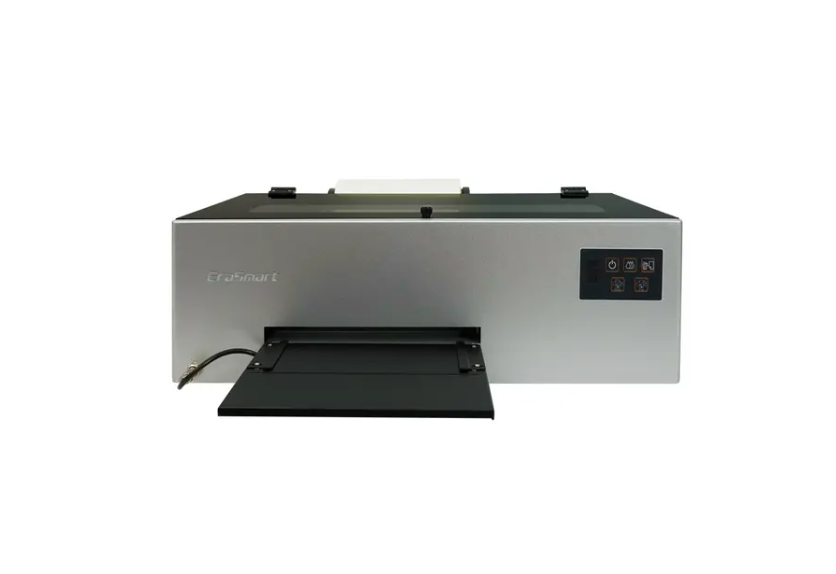
Shopping for a DTF printer can become confusing surprisingly quickly. Two machines may look almost identical in a product photo, yet behave very differently once they are used every day. One may be suitable for a home studio printing a handful of shirts, while the other is designed to stay busy for several hours at a time.
Price and printing speed matter, of course, but they should not make the decision on their own. Film width, white ink handling, software, maintenance work, and technical support can have a much greater effect on day-to-day production. A printer that saves a little money at the beginning may become frustrating if it wastes film, needs constant cleaning, or cannot keep up with orders.
The sensible place to start is your own workload. Think about what you print now, what customers usually order, and how much production you can realistically expect over the next year. Once those points are clear, comparing different DTF printer models becomes far less complicated.
Try not to describe your workload simply as “small” or “commercial.” Those words can mean almost anything. A better approach is to look at a normal working week and estimate how many designs or meters of film you actually need to produce.
Suppose you run a home-based customization business and receive several T-shirt orders each evening. A compact desktop machine may handle that work without taking over the room. It will also be easier to maintain and less expensive to keep supplied with ink and film.
Now consider a garment shop that regularly receives team uniform orders or sells transfer sheets to other businesses. Loading individual sheets again and again would soon become inefficient. In that case, a roll-fed DTF printer would make more sense because it can keep several designs moving through production with less manual handling.
It is reasonable to leave room for growth, but buying far beyond your current needs can create its own problems. Larger equipment needs more space and should usually be operated regularly. When a white ink printer sits unused for long periods, maintenance does not disappear; in many cases, it becomes more demanding.
Choose enough capacity to handle busy periods, but make sure the machine will still be used consistently.
Print width determines more than the largest image you can produce. It affects how many designs fit on one sheet, how much film is wasted, and how often materials need to be loaded.
An A4 DTF printer is usually most useful for small graphics rather than full-size garment designs. Typical jobs include chest logos, names, sleeve prints, labels, children’s clothing, and personalized accessories.
Its compact footprint is a real advantage for a home studio or small shop. The initial cost is also normally lower, so it can be a practical way to test a new customization business without committing to a large production setup.
The drawback appears when larger orders arrive. A full front graphic may not fit comfortably, and arranging several designs on a small sheet can leave awkward gaps. Operators may also spend more time loading film and preparing separate print runs.
For genuinely small-format work, A4 is perfectly usable. For frequent adult T-shirt graphics, it may start to feel restrictive quite quickly.
A3 is often the more flexible choice for a small commercial printing business. It has enough space for many standard garment graphics while remaining compact enough for a modest workshop.
The wider area also makes it easier to combine small logos, names, and illustrations on the same sheet. In real production, that can save both film and operator time. It is especially helpful when several customers place different small orders on the same day.
Custom clothing shops, online sellers, small garment workshops, and promotional product businesses often find A3 equipment easier to grow with. It costs more than an A4 unit, but it is less likely to become limiting as order sizes increase.
A roll-fed DTF printer becomes worthwhile when production is regular and repeatable. Rather than loading one sheet at a time, the operator can arrange multiple graphics along a continuous roll.
This setup is useful for gang sheets, wholesale transfers, teamwear, workwear, and repeat clothing orders. It is normally paired with a powder shaker and curing unit, allowing the printed film to move directly into the next production stage.
However, a roll-fed system needs more than an empty corner. Space is required for the printer, curing equipment, ventilation, film collection, consumables, and routine maintenance. The investment makes the most sense when there is enough work to keep the system running regularly.
It is easy to focus on the printer and treat everything else as an accessory. In practice, the printer is only one stage of the job.
The artwork first needs to be prepared in RIP software. The machine then prints the color and white layers onto PET film. While the ink is still wet, hot-melt powder is added. After the powder has been cured, the transfer can be pressed onto the garment.
For occasional orders, powder may be applied by hand and cured in a compact oven. This keeps the starting cost lower, but the operator needs a steady technique. Uneven powdering can leave rough edges, weak adhesion, or unnecessary adhesive around the image.
A busier shop may prefer an automatic powder shaker. It spreads the powder, removes the excess, cures the transfer, and collects the film with less manual handling. The result is generally more consistent, particularly during longer production runs.
The printer and curing equipment should also be properly matched. There is little value in buying a fast printer if the oven or powder shaker cannot process the film at a similar pace. In that situation, the bottleneck simply moves from one machine to another.
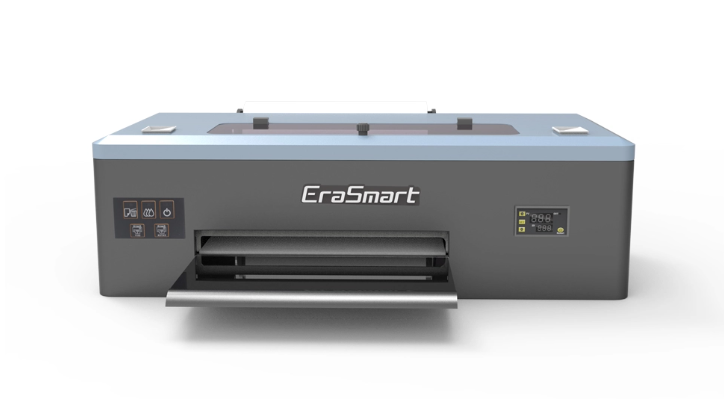
RIP software has a direct influence on how smoothly the printer is used, yet it is often checked only after the machine arrives.
The software controls the white ink layer, color output, image mirroring, print resolution, ink density, and arrangement of designs. A good package should allow an operator to adjust the white base without rebuilding the artwork each time. It should also make it easy to place several graphics together and save settings for repeat jobs.
Before ordering, confirm which operating system the software supports and whether the license has an expiry date. Ask whether usable color profiles are included rather than assuming they will be available.
This matters particularly for first-time users. A clear installation guide and a prepared print profile can save days of testing. Without them, even a mechanically reliable DTF printer may be unnecessarily difficult to set up.
Do not base a purchase on one colorful logo printed under ideal conditions. Ask the supplier to produce samples that are closer to the work you expect to receive.
Fine lettering can reveal whether small details remain clear. Gradients and skin tones show how smoothly colors are reproduced. Large solid areas make banding easier to notice, while graphics with thin outlines can expose poor alignment between the color and white layers.
The transfer should also be examined after heat pressing, not only while it is still on the film. Check the edges, surface feel, white coverage, and flexibility of the finished image. A print that feels excessively thick may be uncomfortable on lightweight clothing.
Wash testing is equally important. Some transfers look excellent immediately after pressing but begin to crack or lift after repeated washing. Testing on cotton, polyester, and blended fabric gives a more useful picture of the complete ink, film, powder, and curing combination.
The printer price is only the first expense. Regular production also uses ink, film, powder, cleaning fluid, electricity, and operator time. Failed prints and wasted materials need to be included as well.
Wear parts are another practical consideration. Dampers, capping stations, wipers, and printheads will not last forever. Ask how much they cost, whether they are normally kept in stock, and how difficult they are to replace.
A low-priced machine can become expensive when it consumes too much ink or repeatedly wastes film. At the same time, paying for a larger and faster printer does not make sense when it spends most of the week idle.
It is usually more useful to estimate the cost of producing your common transfer sizes than to compare machine prices alone. That calculation gives a clearer idea of pricing, margins, and the order volume needed to recover the investment.
An A3 DTF printer suits many small commercial users because it can produce common garment graphics without requiring the space of a large roll-fed system. An A4 model may be sufficient for small logos and occasional orders, while businesses producing gang sheets or wholesale transfers will usually need wider equipment.
No. The artwork is printed onto PET film first. Hot-melt powder is then applied and cured before the image is transferred to the garment with a heat press. This indirect process is what allows the same design to be applied to different textile products.
Daily printing is not always necessary, but regular use helps keep the white ink system in better condition. When the machine will remain idle for several days, the ink circulation, cleaning, and shutdown procedures provided by the supplier should be followed carefully.
A single-printhead printer may be enough for occasional or lower-volume work. Dual-printhead equipment generally produces transfers faster because color and white ink are handled separately. The better choice depends on workload rather than printhead quantity alone.
Look beyond the machine specifications. The supplier should be able to explain software installation, daily maintenance, white ink management, recommended consumables, warranty terms, and spare-part availability. EraSmart provides compact and roll-fed DTF printer options for custom apparel shops, print-on-demand sellers, and garment workshops, helping buyers select a configuration based on print width, production volume, workspace, and operating requirements.


