
Views: 0 Author: Site Editor Publish Time: 2026-05-20 Origin: Site


Some products are awkward from the start. A curved thermos, a textured toolbox, an installed machine panel, or a small item with strange edges can make direct printing slow and risky. Traditional flatbed UV printing works beautifully on many objects, but it still asks you to place the object inside the printer. That means height limits, jigging, alignment work, and sometimes a lot of frustration.
A dual head UV DTF printer solves this problem in a different way. Instead of printing directly onto the object, it prints the graphic onto film, cures it, laminates it, and turns it into a transfer sticker. You then apply the finished design to the product surface. For custom shops handling mixed materials and irregular shapes, this can be a serious workflow upgrade.
The sections below explain how the system works, where it beats older methods, and what to check before buying.
Faster layered output: Dual heads allow white, color, and varnish layers to move through production more efficiently.
Less manual labor: UV DTF removes vinyl weeding and reduces the need to position bulky objects inside a flatbed printer.
Flexible application: Finished crystal stickers can be applied to glass, acrylic, metal, leather-like surfaces, plastics, and many curved products.
Good short-run economics: Small custom orders become easier because there is no screen setup and no object-specific printing jig for every job.
A true dual head printer divides the work so the machine is not forcing one head to do everything slowly. In a typical setup, one head handles the white base and CMYK color. The second head applies varnish with accurate registration. That varnish is not just decoration. It adds gloss, scratch resistance, and a slight raised feel that customers often associate with premium decals.
White base: The printer lays down an opaque foundation so colors stay bright on dark surfaces.
CMYK color: The artwork is printed over the white layer with fine detail.
Varnish: A clear layer protects the graphic and adds a glossy or dimensional effect.
UV LED curing: The ink is cured quickly, becoming solid and durable.
A/B film lamination: The machine laminates the printed film so the decal can be transferred cleanly to the product.
The finished transfer is thin, glossy, and more refined than a thick vinyl sticker. It is often called a crystal sticker because the printed layer appears clean and slightly raised without leaving a bulky border.
Layer | Component | Purpose |
|---|---|---|
Top | B-Film Transfer Layer | Carries the graphic during application and is peeled away afterward. |
Second | UV Varnish | Adds gloss, surface protection, and a raised finish. |
Third | CMYK + White Ink | Creates the visible full-color design with an opaque backing. |
Fourth | Adhesive | Bonds the printed layer to the final hard surface. |
Bottom | A-Film Carrier | Supports the decal during printing and is discarded before transfer. |
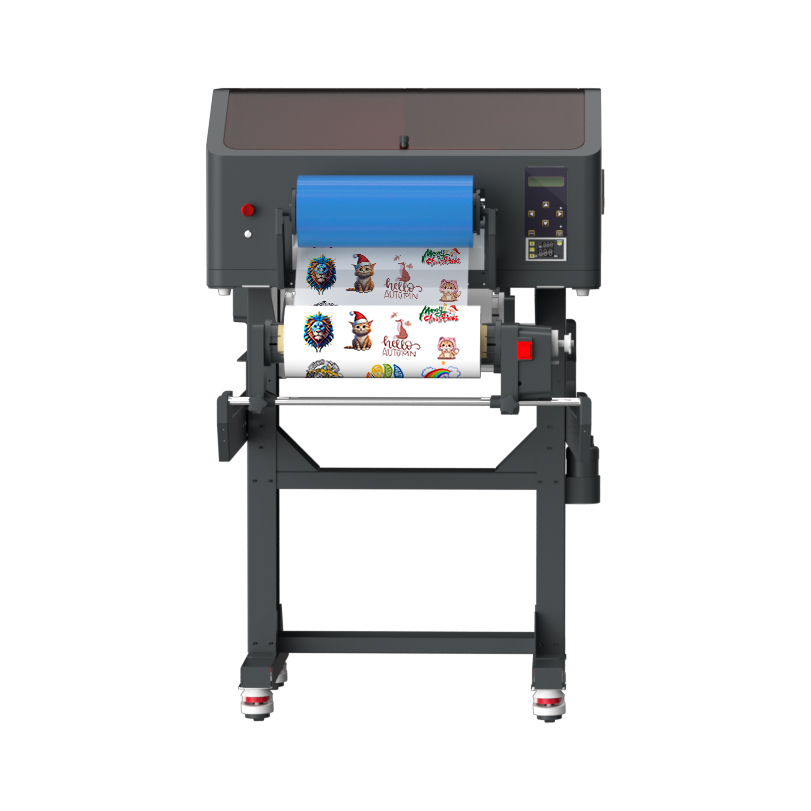
Vinyl has one unavoidable problem: weeding. Small lettering, fine lines, and detailed artwork can turn into slow handwork. A commercial sticker transfer printer prints only the artwork itself. There is no extra vinyl background to remove. For detailed logos or small custom names, that labor saving is often the main reason shops switch.
Direct UV flatbed printing is excellent when the object is flat, clean, and fits inside the machine. But it becomes slower when the product is bulky, oddly shaped, already installed, or difficult to fixture. UV DTF printing avoids that constraint. You produce the decal first, then apply it wherever the product is—on a cooler, bottle, machine casing, acrylic panel, or curved promotional item.
Screen printing is efficient for large, repeated, simple runs. It is not efficient for one-off full-color pieces. If a customer wants a single custom thermos with a detailed logo, screen setup costs quickly become unreasonable. UV DTF keeps the job digital from start to finish, which makes low-volume customization easier to price and easier to accept.
Feature | Traditional Vinyl | UV Flatbed | UV DTF |
|---|---|---|---|
Manual Weeding | Required | Not required | Not required |
Object Height Limit | No printer limit | Strict | None after transfer is made |
Jig Requirement | Low | Often high | Low for application |
Full-Color Detail | Difficult | Excellent | Excellent |
White UV ink contains heavy pigment, so it needs movement. A commercial UV DTF sticker printer should include white ink circulation and stirring. Without it, clogs become more likely, especially if the shop does not print every day.
An integrated laminator keeps the workflow cleaner because the film moves from print to cure to laminate without extra handling. A standalone laminator can work, but it adds another step and another alignment point. For busy shops, fewer handoffs usually mean fewer mistakes.
Look beyond the advertised resolution. Ask for samples with tiny text, gradients, thin lines, and varnish edges. A transfer that looks sharp from a distance may reveal misregistration when applied to a glossy product.
UV DTF transfers are attractive because setup is light. A small 4x4 inch transfer can often be produced at a low material cost, depending on ink coverage, film pricing, and waste. The more important point is that short-run full-color work becomes commercially realistic. A shop can accept one-off labels, branded samples, event gifts, and mixed product batches without preparing screens or cutting vinyl.
Facility conditions still matter. Keep dust away from film, maintain stable temperature, and provide ventilation around UV equipment. Operators should wear gloves when handling transfer film so oils from fingers do not affect adhesion.
Before buying, check RIP software compatibility, spare part availability, printhead warranty terms, training materials, and vendor response time. A transfer printing machine is only productive if the seller can support it when something goes wrong. Ask for live video tests, not only polished sample photos.
A dual head UV DTF printer is a strong option for shops that handle mixed hard-surface customization. It reduces weeding, bypasses flatbed height limits, and makes short-run full-color transfers easier to sell. The best results come from choosing a machine with stable white ink circulation, accurate lamination, reliable curing, and usable software. If those basics are weak, the promised speed will not matter for long.
On compatible hard surfaces, they can be quite durable and scratch-resistant. Adhesion still depends on the substrate, cleaning method, and application pressure.
Very soft silicone, heavily textured surfaces, oily coatings, and some low-energy plastics may not bond well without treatment.
Yes. Expect nozzle checks, capping station cleaning, white ink circulation checks, and careful film handling. Daily care protects the printheads.


